
Hampi: A City Written in Stone
India · Cultural landscapes · A field guide
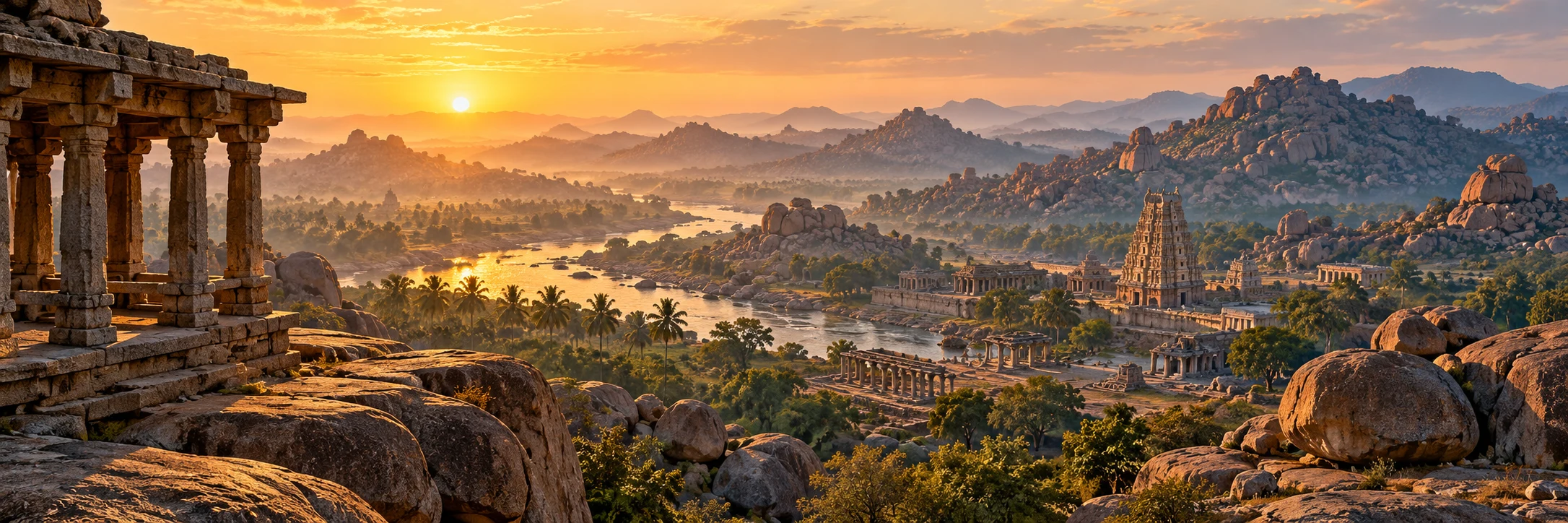
At Hampi, the landscape is part of the story. Granite hills, open ground and the river setting invite you to connect individual monuments rather than treating them as isolated sights. A rewarding visit begins with a simple change of scale: look at a detail, then look at the space around it.
A capital across the landscape
The UNESCO-listed Group of Monuments at Hampi preserves remains of Vijayanagara, an imperial capital of the fourteenth to sixteenth centuries in Karnataka. The Tungabhadra River and rocky terrain frame a wide range of surviving structures. Temples, royal buildings, market spaces and water features reveal a city with many interconnected functions.
This diversity is the starting point for a richer reading of the place. Sacred architecture was one part of urban life; movement, exchange and water management matter too. Look for interpretation that explains how a monument relates to the surrounding city.
Choose a question before a route
Try building your visit around one question: how did people move through this space? At a gateway, notice the direction of approach. Beside a pillared structure, consider what its position helps you see and what it screens from view. At a water feature, ask how its function has been established. These are observation prompts, not substitutes for archaeological interpretation.
A map is particularly useful for this exercise. Mark the places you actually visited and keep them distinct from the wider area shown in a guidebook. A short, carefully understood route can be more memorable than a list of monuments seen in a hurry.
Read details without inventing stories
Carving, material and scale can all draw your attention. Start by describing them in ordinary language. Then use a site label, museum explanation or reliable publication to add names and context. When a claim concerns a structure’s original purpose, record the source rather than treating a modern nickname as proof.
Try taking one wide photograph and one detail photograph from permitted viewpoints. Add a sentence explaining their relationship. This creates a useful record of your visit without suggesting that an attractive image tells the whole history.
Leave room for a living place
Check local guidance before entering religious spaces, photographing people or joining a ceremony. Follow marked routes, respect conservation work and do not climb carved remains for a better view. Ask permission where it is appropriate and allow other visitors space.
Before departure, verify current access and transport arrangements with official local sources. Review the distances and terrain against your own needs. A heritage description explains significance; it does not replace practical information for the day of your visit.
Your field notebook
Bring home three things: a sketch of one relationship between buildings, the source of one historical claim and one unanswered question. Together they turn a striking landscape into the beginning of a continuing enquiry.
UNESCO: Group of Monuments at Hampi ↗
Explore all destinations → · Build your research notebook →
Original editorial guide. Historical overview informed by UNESCO, checked 29 October 2026. Visiting and observation suggestions are editorial guidance; confirm current arrangements separately.